Industry: Agriculture | Direct-to-Consumer Commerce
Focus: Workflow Automation | CRM Design | Operational Systems
Role: Product Strategist & System Designer
Tools: Airtable, Google Forms, Google Sheets, Zapier, Google Voice
- Designed an Airtable CRM and order fulfillment system connecting customers, inventory, orders, and compliance records
- Reduced manual customer outreach by 80% through self-service ordering and repeat purchase workflows
- Digitized paper-based processes while preserving the personalized customer experience that differentiated the business
Project Overview
Idaho Beef is a family-owned agricultural business delivering farm-raised beef from rural Idaho to customers across Washington and Oregon.
As the customer base grew, the business relied heavily on paper records, verbal communication, and institutional knowledge to manage orders, inventory, customer relationships, and regulatory tracking. The owner spent a significant portion of each sales cycle manually contacting previous customers to ask whether they wanted to reorder.
The challenge wasn’t digitization—it was preserving the personalized service customers expected while creating a system that could support growth.
“We need to grow, but I need a way to stop messing up order details. There’s too many of them; these mistakes are killing my pockets.”
The project objective became reducing operational complexity while maintaining visibility, compliance, and personalized service.
- Customer records existed in multiple locations.
- Orders, inventory, and customer information were not linked.
- Repeat ordering required manual outreach.
- USDA traceability requirements relied on paper records.
- Custom requests and delivery preferences were difficult to track consistently.
- Business knowledge lived primarily in the owner’s memory.
Requirements gathering revealed two distinct user groups with different priorities: customers prioritized convenience and flexibility, while the owner required centralized records, inventory visibility, and administrative control over order fulfillment and regulatory tracking. Success would be measured by reducing manual effort while maintaining the customer experience that differentiated the business.
- Objective 1: Reduce manual customer outreach and administrative effort.
- Objective 2: Centralize customer, order, inventory, and compliance records into a single operational system.
- Objective 3: Support growth without increasing operational overhead.
- Objective 4: Preserve the personalized customer experience while digitizing operations.
Solutions provided
1. Digital Customer Ordering Experience
Before implementation, customers placed orders through phone calls or text messages. However, because Idaho Beef specializes in custom beef orders rather than standardized packages, each order required a series of qualification questions to determine product preferences, processing requirements, and packaging options.
The ordering process depended heavily on the owner’s expertise and memory to translate customer requests into accurate fulfillment instructions.
I designed a customer-facing ordering workflow that embedded these qualification questions directly into the ordering experience.
Customers could:
- Specify order size and product preferences
- Select processing and packaging options
- Communicate special requests
- Request a callback for unique situations or additional guidance
Rather than replacing the personal service customers valued, the workflow automated routine conversations while preserving opportunities for human interaction when needed.
Returning customers could reorder previous purchases with significantly less effort, reducing friction for both customers and the business owner.
2. CRM and Order Management System
Using Airtable, I designed two connected operational systems: a Customer CRM and an Animal Tracking database.
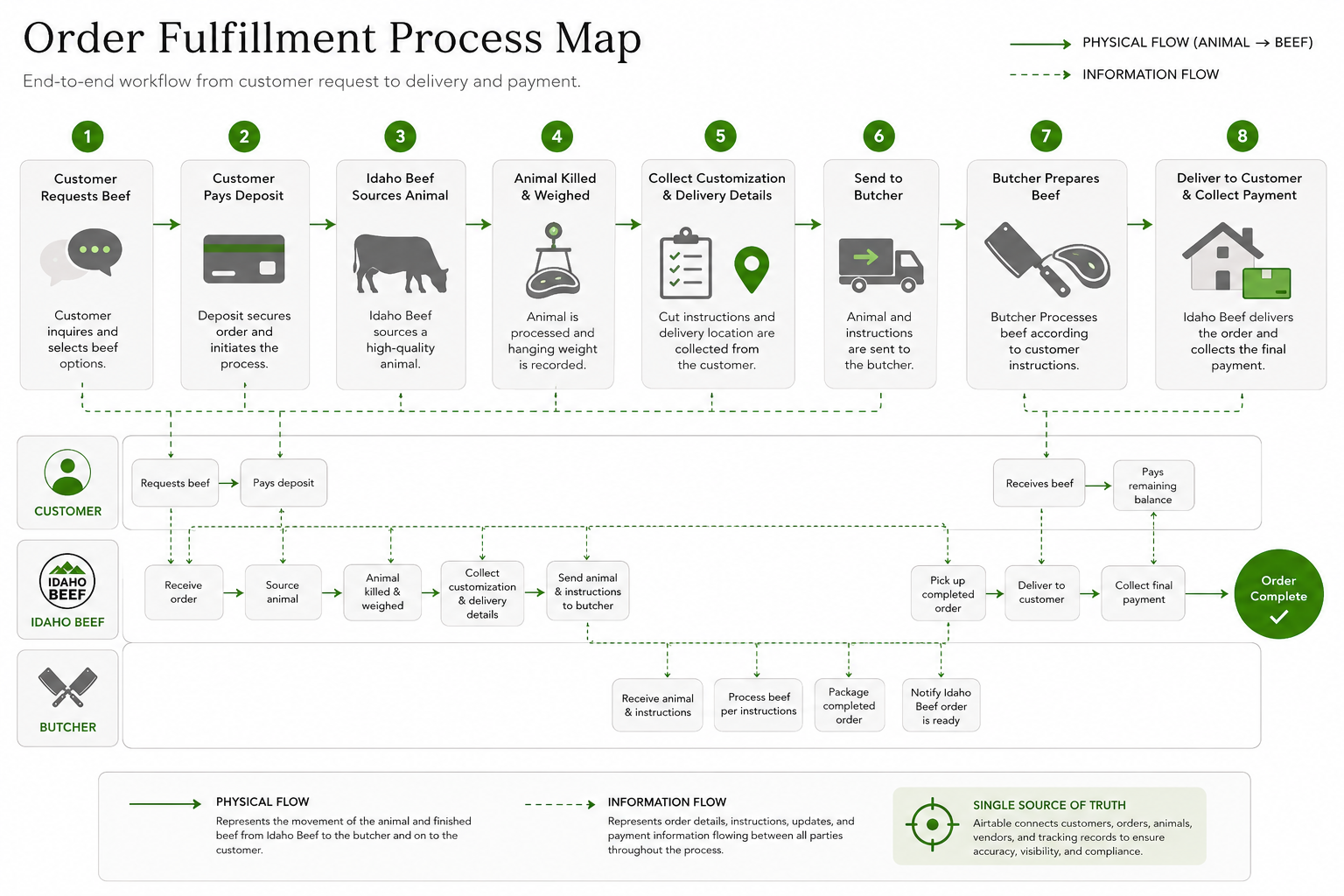
When a customer order entered the system through an automated workflow, it was linked directly to the customer’s record and captured:
- order details and fulfillment status
- custom cutting and packaging instructions
- processing vendors responsible for fulfillment
- final pricing and payment information
Each order was also connected to an individual animal record containing:
- supplier information
- animal identification details
- USDA traceability records
This relationship created a complete chain of custody from customer order to source animal, improving operational visibility while supporting regulatory compliance requirements. Each order served as the link between customer records and animal records, allowing the business to trace a finished order back to both the supplier and the individual animal that fulfilled it.
The result was a single source of truth for customer history, fulfillment status, supplier relationships, and product traceability.
3. Automation Layer
Google Forms submissions flowed automatically through Google Sheets and Zapier into Airtable.
Automations:
- Flagged callback requests.
- Created new customer records
4. Operational Visibility
Customer outreach remained an important part of the Idaho Beef experience, particularly for custom orders and delivery coordination.
To support these workflows, I implemented Google Voice integration within Airtable using custom scripts that allowed the owner to place calls directly from customer records.
By reducing context switching and keeping communication workflows connected to customer data, the system improved efficiency while preserving the personal service customers expected.
Results
| Metric | Outcome |
|---|---|
| Customer records | 100% digitized |
| Manual outreach | Reduced by approximately 80% |
| Compliance tracking | Fully searchable and auditable |
| Scalability | Increased without increasing administrative burden |
- Reduced manual customer outreach by 80% through self-service ordering and repeat purchase workflows.
- Created a centralized source of truth for customer, order, supplier, and compliance data.
- Improved order accuracy by standardizing customization and processing instructions at intake.
- Preserved the personalized customer experience while reducing operational overhead.
- Supported business growth without increasing administrative burden.
The system transformed Idaho Beef from a memory-driven operation into a scalable business platform while preserving the personal service customers valued most.
Conclusion
This project reinforced the importance of designing around existing user behavior rather than forcing entirely new workflows. By combining requirements analysis, automation, and user-centered design, I created a system that improved operational efficiency without sacrificing the personal relationships that defined the business. The result was a scalable foundation that supported growth while remaining true to the company’s values.