
Industry: Small business operations
Focus: Workflow Automation | Operations Management | Payroll Intake
Tools: Airtable, Airtable Forms, Airtable Automations
Role: Workflow Architect & Airtable Systems Designer
- Designed a mobile-first payroll collection workflow for 30+ distributed workers.
- Reduced payroll administration time by 80%.
- Standardized payroll submissions and reduced correction requests by approximately 70%.
- Created an automated reporting workflow that transformed payroll from a compilation exercise into a review process.
Project Overview
A small business relied entirely on text messages to collect worked hours from approximately 30 field-based vendors each week.
Workers submitted hours individually through SMS messages, requiring the owner to manually:
- collect submissions across dozens of message threads
- total hours
- identify missing submissions
- correct obvious errors
- manually enter payroll information into ADP
As the business grew, payroll processing became increasingly time-consuming and difficult to manage.
The owner’s desired future state was simple:
“If totals are ready every Wednesday morning, I can simply enter instead of compiling anything.”
The project objective became reducing payroll administration while maintaining oversight and preserving employee privacy. Requirements gathering revealed two distinct user groups with competing needs: workers prioritized speed and simplicity, while the owner required visibility, validation controls, and administrative oversight.
- Objective 1: Reduce payroll processing time.
- Objective 2: Eliminate manual aggregation of hours.
- Objective 3: Standardize submissions across employees.
- Objective 4: Maintain administrative control over payroll corrections.
- Objective 5: Prevent employees from accessing other workers’ information.
Solutions provided
- Mobile Payroll Submission Workflow Workers were previously required to text their hours each week using a specific format that payroll could interpret and manually compile. I replaced this with a mobile-friendly submission form accessible from a single link.
- Workers could:
- Select their name
- Select the current pay period
- Enter hours worked
- Submit their hours from their phone and receive confirmation that payroll had received the submission.
- Workers could:
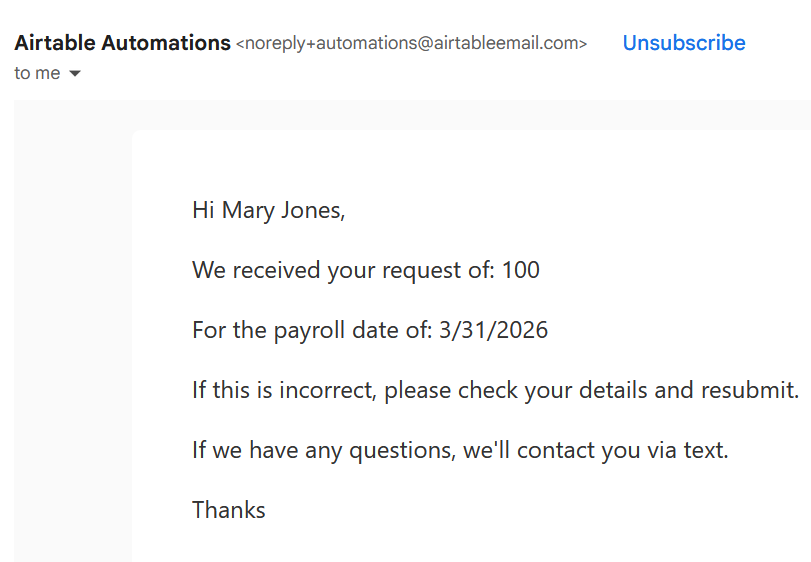
The process intentionally mirrored the simplicity of sending a text message while creating structured data on the backend. View the submission form.
2. Data Validation & Error Prevention
Several guardrails were introduced to reduce payroll mistakes:
- standardized employee names
- restricted pay-period selection
- predefined locations and shifts
This allowed the owner to quickly identify and fix issues such as:
- 200 hours entered instead of 20
- duplicate submissions
- incorrect pay periods
3. Airtable Interface Dashboard
An Airtable interface provided a simplified payroll dashboard showing:
- employee submissions
- weekly totals
The owner never needed to navigate the underlying database structure. Sensitive compensation information remained entirely within ADP.
Results
| Metric | Before | After |
|---|---|---|
| Payroll processing time | 2.5 hours | 0.5 hours |
| Payroll correction rate | 10% | 3% |
| Submission channels | 30+ text threads | Single intake form |
- Reduced payroll processing time from 2.5 hours to 0.5 hours. (Objective 1)
- Eliminated the need to manage payroll across dozens of text message conversations. (Objective 2)
- Reduced payroll corrections and resubmissions from approximately 10% to 3%. (Objective 3)
- Created a centralized payroll record that improved visibility into submissions and simplified issue resolution. (Objective 4)
- Supported growth without increasing administrative burden.
Rather than forcing users to adopt a fundamentally new process, the solution preserved the simplicity of the existing text-message workflow while introducing structure, validation, and automation behind the scenes.
Conclusion
This project highlights the value of requirements analysis and user-centered workflow design in operational systems. By identifying the needs of both payroll administrators and field workers, I designed an experience that minimized friction while supporting business goals around accuracy, efficiency, and privacy. The result was a scalable payroll process that improved both the employee experience and operational performance.

